
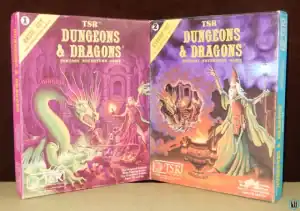
Your world’s genre and the rule system that supports it may seem like a foregone conclusion – in this series, we’re talking about using the Basic/Expert D&D rules, written to run games in a fantasy setting, so that’s done and dusted, right?
Perhaps not. Running B/X out of the box is good enough for a one-shot, or a string of loosely connected one-shots, but as the characters advance, you’ll introduce new challenges, new monsters, more powerful magic items, and higher-level spells. There’s a risk that the power creep can significantly alter the setting’s foundation. And – to be sure – while the characters’ rise to glory will have an impact on the setting, it should not drastically alter the world meta.1Some will take issue with this assertion, and they will rightly offer excellent examples of where I’m wrong: The Lord of the Rings, The Wheel of Time, Dune, et al. Certainly the protagonists in those stories do change the world, but a TTRPG World is not the same as a Novel World, and while the latter is great for the author’s narrative, the former is better for players interacting at the table. A sustainable setting is only possible with the players’ engagement, and save-the-world campaigns are, inevitably, railroading, by virtue of the immense consequence of the party’s success or failure. Saving the world absolutely has its place in Appendix N, but I caution against creating a world just so it can be saved. Ultimately, the campaign setting should “feel” like the same place that the characters began to explore at 1st-level.
Think of it this way: The player characters will face increasingly tougher challenges as they advance in level. As kobolds and giant rats give way to ogres and dragons, the characters gain access to more powerful abilities necessary to overcome these more powerful challenges. From a worldbuilding perspective, the setting’s framework (i.e., the World Meta) must accommodates great challenges alongside weaker ones as well as powerful abilities alongside the mundane. In other words, the player characters should expect the setting to be consistent as they expand their horizons within it. As a worldbuilder, you must account for this range in both the genre you play and the rules that support it.
N.B. This article contains affiliate links.
Genre
Past articles have covered campaign genres, meaning (in this context), a particular style of play characterised by consistent themes and trappings. Basic/Expert rules are custom-made for fantasy environments, though it’s worth thinking about what flavour of fantasy you want to serve up:
High-fantasy: Magic and wonder rule the day. Spells and magic items aren’t just for adventuring – they’re used as a proxy for technology, so magic will power transport (airships, teleportation), provide amenities (the old “fire-elemental-in-the-furnace” trick), and dominate offensive and defensive capabilities at all levels. As a commodity, magic is likely more available to the affluent, and people on the whole are better off with food, water, shelter, and healing. The Forgotten Realms is a good example, but BECMI Mystara probably sets the best tone.
Low-fantasy: Life is gritty and magic is rare enough to be viewed with suspicion or fear. Problems are solved through muscle, economies are based on hard goods, and spells or magic items are significant game changers. Even magical monsters are rare, and when encountered represent a significant challenge. A good example is Martin’s Westeros, where Valyrian steel, obsidian, zombies, and dragons are enough to shift the course of events in an otherwise mundane (non-magical) world.
Implied Setting: My personal favourite, somewhere between Low- and High-fantasy, the implied setting is an environment whose tone and trappings are dictated by the conventions set in the rules. For example, in B/X, adventurers explore dungeons and gain levels by amassing treasure, so the setting’s past requires rich empires that have fallen to ruin. Clerics get spells from deities, so to some extent, the gods are real. Neanderthals attack ogres on sight – not sure why, but the something in the setting has to justify it. Implied settings vary by ruleset and are probably the closest to an “out-of-the-box” experience (read: least amount of tweaking) the Referee can achieve.
There are other sub-genres, of course: horror, apocalyptic, so-called grimdark, etc. But these tend to be specific and may be better suited to areas of your world instead of the entire world.
Rule System
Again, we’re focusing on Basic/Expert D&D, so for purposes of this series, rule system is somewhat of a foregone conclusion. That said, there are subtle variations. First is whether to use B/X, a B/X clone, or a B/X-adjacent system. While I’ll default to Basic/Expert proper, here are other options to consider:
Basic Fantasy RPG: A B/X clone with minor changes (ascending AC and cleric tweaks), plus separation of race and class. Basic Fantasy provides a great many add-ons and modular bits to customise your ruleset, though such additions must be chosen carefully to ensure setting cohesion.
Labyrinth Lord: A B/X clone with some noticeable tweaks, Labyrinth Lord smooths out cleric spell progression and allows some classes rise to levels above their B/X counterparts. Has an “advanced” companion volume to add more class options, spells, and magic items.
Old School Essentials: A B/X clone, the OSE Classic Fantasy tome is essentially identical to original rules. Offers some optional tweaks like ascending AC, THAC0, and minor updates to clarify ambiguities in the original. Also has an “advanced” companion volume with more classes, how to separate race from class, spells, and magic items.
BECMI: The 1983 reboot of B/X. The first two volumes (Basic + Expert) are largely in line with B/X. However, the Companioin, Master, and Immortals volumes greatly extend the B/X canon with general skills, weapon mastery, dominion rules, siege warfare, and a great many more spells, monsters, and magic items. The Rules Cyclopedia is a single volume that consolidates most of the BECMI material (excluding much of the Immortals set). Of particular note is that, while B/X characters max out at 14th-level, BECMI goes to 36, which brings massive implications to the world meta.
Shadowdark: A recent OSR system very much compatible with B/X but with some helpful 5e inclusions (e.g., ascending AC, rolling with advantage, et al.). Relies a lot on attribute checks, and spells are cast with a roll. While I have not played Shadowdark, it’s been favourably described as having an OSR feel with 5e accessibility, and the kids seem to like it.
Select the rule system that best emulates the “feel” for the world and the pacing you want for your games. There’s a temptation to assume that a “fantasy” rule set can run any “fantasy” setting, but consider how the system handles combat, character advancement, spell casting, the use of skills, race-as-class vs. race-and-class, spell selection and even terrain types, as they all have an impact your world meta.
The last consideration here is about house rules. Not that you need a full and complete list of your setting’s house rules now, but you will need to figure out how the house rules you choose impact the genre. For example, if you plan to use a critical hit system that allows characters to dispatch foes with a single lucky strike, consider how it will impact character survivability, challenge level, weapon selection, etc. All of these have subtle influence on your world meta.
Final Thoughts
Your world meta starts with the genre you’re playing and the rules you’re using to support it. If you have a lot of experience running games, you’re probably already familiar with how the system impacts the setting, and our best advice is to stick with what’s familiar so you can frame your world concepts in the most accessible way possible.