
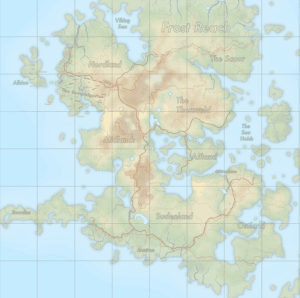
For those keeping score, this blog started with a bold question, posed back in July of 2009: Who Builds a World? At the time, it seemed like a good start for larger discourse on creating homebrew campaign settings. But it turns out that I was biting off more than I could chew, and since that time, I’ve discovered there are as many approaches as there are worldbuilders – that is to say, everyone takes their own path to create what they need.
My journey into worldbuilding has been no different, and since posting that (vague and admittedly directionless) article 16 years ago (!), I feel I’ve gone through enough trial-and-error to understand what works well (for me) and where the tricky spots lie. I hope to resurrect the worldbuilding discussion with the benefit of those insights.
Starting from Scratch
Among my superpowers is asserting pedantic assumptions, so we’ll start with these:
- You’re running a fantasy TTRPG (and in these articles, I’ll lean heavily on the B/X/OSE ruleset)
- You have a lot of creative ideas, but lack a foundation upon which to build them
- You aren’t comfortable with a commercial setting (it doesn’t matter why – you want your own world)
These are the same baselines that I posited in 2009. But I’ve added more in the intervening years:
- You want enough space to accommodate all the ideas that haven’t yet matured in your creative brain
- You want cohesion and depth to make your focus areas engaging to the players
- You have created one-shot regions for short-term play, but they cannot sustain long-term campaigning
It’s with these latter assumptions that most worldbuilders I’ve spoken and worked with find themselves stagnated. In short, they want a full world of fertile ground where they can cultivate creative inspiration into long-term play, but available time limits them to small settings that – by definition – have narrow scope and resist expansion.
Top-down vs. Bottom-up
Broadly speaking, there are two approaches to worldbuilding: Top-down or Bottom-up. Both have their place, but each has their own set of pros and cons.
Bottom-up: Start with a small geographic area that includes a handful of adventure sites, a homebase, and a dangerous wilderness. The area’s limited scope makes it easy to develop quickly, but at the expense of flexibility – once the region’s adventure sites are tapped, the Referee1Or Dungeon Master, GM, or whomever is creating the world and running the game. For consistency, we’ll use the Old-School Essentials appellation Referee. has to expand the setting or create a new one to continue playing. It’s certainly possible to connect these small areas into a larger geography, but they will (inevitably) start to feel inconsistent, especially if the Referee likes to introduce new classes or tinker with rules.
Top-down: Start with a world map that includes continents and cultures. The ostensible value lies in having a complete, cohesive environment. The constants and conventions of the wider world allows the Referee to devise world hooks and engage players with details and mysteries drawn from history, populations, magic, religion, etc. More importantly, it provides a place that can accommodate new ideas; even if those ideas aren’t fleshed out, you can place them and evaluate their potential impact when you’re ready. The challenge is available time and creative stamina – it takes a lot of effort and many, many hours to build and sustain the details of an entire planet.
Most worldbuilding advice supports the bottom-up approach, which is sensible if you and your players are eager to start rolling dice, and especially if time is limited. Grab a piece of hex paper or quickly generate a wilderness map randomly, flesh out some encounters, and you’re off to the races.
But if you’re interested in creating a foundation that can sustain long-term play, engaging cohesion, and ideas you haven’t even thought of yet, I propose the mild insanity of trying your hand at the top-down approach. It will take more time, but you’ll end up with a setting that can house anything you want, whenever you want it.
The goal is to define high-level specs across the globe – dominant races, geographic regions, prominent religions, world events – so you can draw from a common well no matter where you launch a campaign. In other words, you start with the top-down approach, which sets the stage for bottom-up approach later, wherever you want. Think of it as building a house: You don’t start by painting and furnishing each room individually then connecting them together – instead, you create the structure first, enabling you to appoint each room coherently as time, budget, and taste dictate.
But What About…
Let’s nail down the virtues of the top-down approach by addressing some of the common reasons people avoid it:
A full world is hard to get off the ground: Referees are rightly daunted by the prospect of creating a world map, defining global populations, and establishing world history. But these tasks aren’t as hard as they may seem. World maps can be randomly generated, you can define a culture in five sentences instead of 5,000 words, and no one reads pages of fantasy world history anyway. This series will show you how to break up these tasks into highly manageable chunks.
A full world has too much space to fill: Yes, a full world is big, but you don’t have to populate every hex. Creating a full world (as we’ll see in future articles) is about establishing a large environment that enables flexibility. This is a key concept: When a Referee thinks of “filling space,” they’re often talking about creating detail – how many orcs in that lair, what threat do they represent, what treasure do they have, for example. But the top-down approach relies – as implied – on the macro view. In reality, you don’t need to know anything about the orc lair, just that there are orcs in such-and-such a place. You’ll describe them in greater detail later, when (and only after) they become relevant to the campaign.
A full world must be written in stone: As a top-down worldbuilder, you must quickly divest yourself of the notion that you have to define everything right out of the gate. The desire to do so specifically contradicts another piece of advice we often hear as Referees: That players don’t like being railroaded and that campaigns actually suffer from it. If we’re to avoid railroading (i.e., creating plots where we expect the players to react the right way in a series of sequenced encounters to reach the Referee’s desired conclusion), we should also avoid the temptation to constrain the environment with detail. In top-down, there is no “set it and forget it” – things are (and should be) fluid.
A full world requires too many decisions you’re not prepared to make: A corollary of sorts to the last point, this concern speaks to the pressure many Referees feel to entertain the players with a fully engaging environment. The Referee assumes that they’re solely responsible for not only creating that environment, but also setting the right course for every campaign within it – what if the players don’t buy into the Referees’ vision? But if you’re creating at the macro level, all you’re really providing is a rough outline of that vision. Given interesting hooks, the players will complete your vision for you by selecting the hooks they care about. This dynamic ensures that you’re detailing only what the players want to be detailed, and if you listen carefully, their input will do most of the heavy lifting for you. The benefit of the top-down approach is that you’ll have an entire world in which to grow the seeds the players plant.
Final Thoughts
We’re on the first step of a larger effort, and this series will walk you through the process of creating a top-down world. When we’re done, you’ll have a full world map and a referenceable gazetteer to describe what’s on it. It will take time, but you’ll end up with a world sufficiently functional for immediate play while remaining flexible enough to grow with your creative impulses over time.
Half the effort is organising your approach to avoid unnecessary work and instead focus on the minimum level of detail needed to play. I’ll share my process; the tools, tables, and templates I use; and live examples to show my work. There will be some thoughts on how game systems impact setting, world design shortcuts, rambling philosophy, and the occasional heresy. You will not be quizzed.
If you want to follow along, please consider signing up for email notifications when new articles are posted (use the form in the footer below). You can also catch up on articles in this series using the “Top Down Worldbuilding” tag.
Thanks for reading, and I hope to see you along the way.
I’ve been rereading old articles and found these recent posts when I got to yours. I’m very excited to see where this goes. I have used your hex-based campaign design articles and related resources as part of my campaign building paradigm several times over the past decade. I sometimes modify your process a bit, and often layer other methods (like those in “Beyond the Wall and Other Adventures”) on top of your tools to flesh out my maps.
Hey Hildy,
Thanks for reading, and I’m glad the hex-based campaign articles are useful (I love the Scenario Pack approach from Beyond the Wall). This series takes the opposite approach of the Hex-Based Campaign Design guidance, but the two systems are complementary. With a top-down world established at the macro level, one can then take the hex-based approach for the micro level later, with the added benefit of greater context.
The series has a ways to go – a few more weeks on the World Meta, then onto creating the world map, then finishing up with the World Gazetteer. After that, probably more tools and templates for populating atlas and regional maps.
Thanks again,
-Erin